Parliament


MP Elysa Chen suggests redistributing anti-scam fines collected from platforms to victims under 'spirit of fairness'
She also gave suggestions to protect people who get genuinely misled or coerced into becoming a scam mule.
September 09, 2026, 02:13 PM
Photos from MDDI's YouTube and Canva


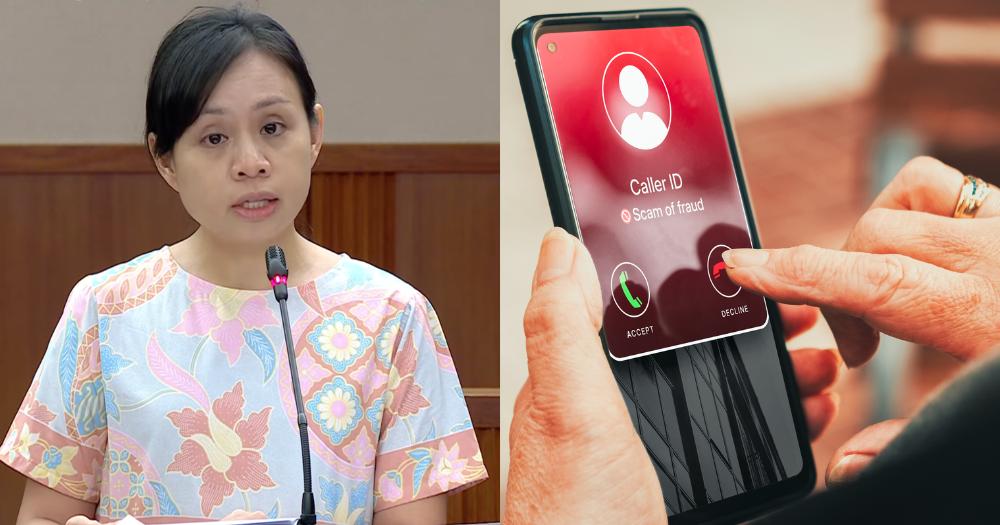
In Parliament on Sep. 9, Member of Parliament (MP) Elysa Chen called for the government to consider restitution for those who fall victim to scams on non-compliant platforms, as a form of economic redress.
"Under the spirit of fairness and justice, can we consider redistributing the fines collected to the victims of the very scams the platforms were fined for?" she put forth.
She was speaking during the continuing Parliamentary debate on the Scams (Countermeasures) and Other Matters Bill, which she supports.
Under the Online Criminal Harms Act, online platforms such as WhatsApp, Telegram, Carousell, Facebook, Instagram, and TikTok are required to impose preventive anti-scam measures.
Currently, those who do not comply may face a fine of up to S$1 million if they do not act on the Rectification Notice they are issued.
Chen said she welcomes the financial penalties on non-compliant platforms, but noted that the fines collected flow to the state, not the victim.
Thus, she proposed that the new Bill make redress to the victims.
'They keep coming back like zombies'
Speaking strongly against scams, Chen expressed frustration about the difficulty in tackling them.
"I hate how they keep coming back like zombies — we shut one account down, and two more spring up within an hour."
She also pointed out how scammers prey on the most vulnerable — people who may be deceived and coerced.
She shared several "heartwrenching" stories, including one she heard from a Meet-the-People (MPS) session involving a widow whose husband died from a terminal illness.
He had transferred large sums of money to a scammer, thinking that he was investing money to leave more for his wife and children, she said.
The year 2025 saw 37,308 scam cases, with a total of S$913.1 million lost.
While supporting the new Bill, Chen highlighted areas of concern she had when it comes to people who get deceived into scams.
"The measures must strike at the right targets...
A Bill that stops scammers only to catch the vulnerable in the same net will have solved one injustice by creating another."
Protecting those deceived or coerced
Chen highlighted that people may unwittingly become scam mules.
"What if someone was genuinely misled or coerced into handing over his account?" she questioned.
Giving an example, she described a situation where an elderly aunty was deceived into handing over her bank login details for a small token payment she believed was legitimate.
"She would be presumed, until she proves otherwise, to have had reasonable grounds to believe her account would be misused — a presumption she may not have the ability to rebut on her own."
Chen proposed that the government provide opportunities for review through an avenue outside of the police.
She also suggested setting a minimum gain threshold for scam mules, so that "a token sum does not sweep in those who have been deceived alongside the complicit".
She went on to question the punishment for scam mules by restricting their access to SingPass, wondering if that may inadvertently cut people off from essential civic services such as healthcare and CPF matters.
Senior Minister of State for Home Affairs Goh Pei Ming later responded to this point, assuring her that will not happen.
He clarified that the SingPass restrictions will only be targeted at services that are at higher risk of being exploited for scams, such as opening a bank account. Services such as healthcare and CPF matters would remain fully accessible.
At the same time, people can still open a bank account without a SingPass, he added.
In response to the proposal of a minimum gain threshold, he said that he had concerns with such an approach.
"Whatever gain threshold that we set, scam mules are likely to endeavour to go below it to escape liability and frustrate law enforcement efforts.
The government's view is that the presumption should apply so long as there is gain, no matter how small."