



News


PMEs must be supported in the AI era & beyond as tomorrow's 'working class': Ng Chee Meng
He shares his thoughts of the future of the workforce and how he seeks to support it.
August 01, 2026, 11:20 AM
Photos from Mothership and GovTech


Will artificial intelligence (AI) take over my job?
It's a question that dominates conversations about jobs and the workforce today.
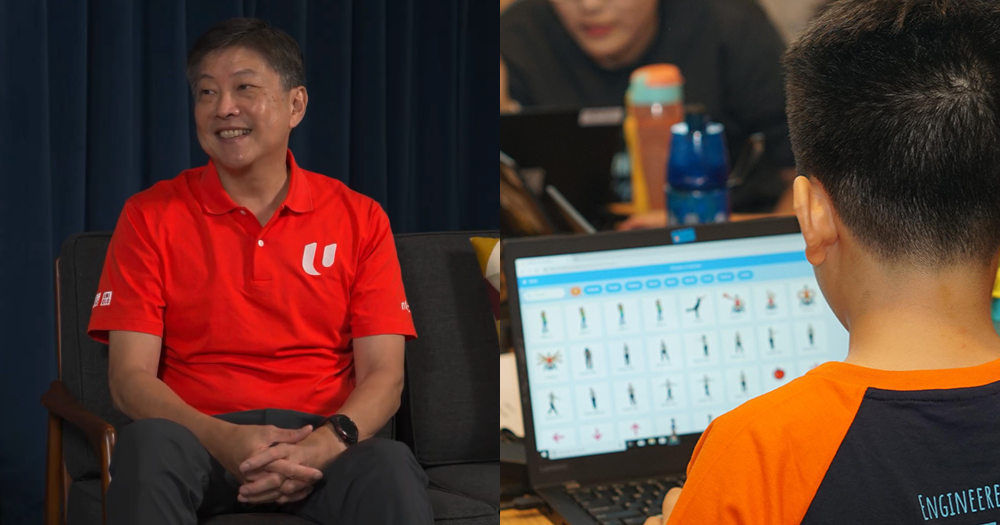
As the secretary-general of the National Trades Union Congress (NTUC), Ng Chee Meng has heard his fair share of anxieties about AI from workers.
But he has found that most Singaporeans, especially the younger generation, are "go-getters" who will continue to upgrade their skills.
Speaking to Mothership, he shared that he has been "very impressed" when working with youths.
He described them as passionate, creative, and "much more willing to dream and [be daring]", compared with his own "more conservative" generation.
"I have great confidence that we are able to energise and look at AI as new frontiers and possibilities," he said.
"Yes, there will be challenges, but can we overcome them? I'm confident we can."
Threat vs. enabler
Not every sector views AI as a threat, Ng pointed out.
In sectors "where there is growth and a dearth of labour", workers see the technology as more of an enabler.
He brought up healthcare as an example where professionals have mostly embraced AI to help them with routine tasks, such as planning their work shifts.
He has also spoken to people in aviation who are excited to find ways to use AI to improve productivity for themselves and for their company.
But turning to people from other industries, such as programmers and coders, the threat of AI is "very real", Ng said.
He candidly admitted NTUC is still exploring how to support workers in the tech sector and is monitoring the full impact of AI there, given how fast the sector has been evolving.
Redesigning jobs
To minimise the adverse impact of AI, Ng believes Singapore can encourage companies to take a different approach from those overseas.
Some companies in the West, he observed, are quick to lay off workers after embracing new technology.
But they would start hiring again in about a year, realising that they still need human talent.
"Instead of doing this kind of thing, why don't we discover that actually that may not be the best business model?" Ng questioned.
Thankfully, he said, Singapore is having better conversations to explore strategies that benefit both workers and companies.
NTUC has been looking at retraining workers and redesigning jobs in line with AI adoption.
That said, "NTUC doesn’t think for a second that we have all the answers", Ng caveated.
He explained that the union partners tech leaders such as Amazon Web Services and Huawei to build AI-driven business models and support companies in their digital transformation.
Providing a buffer
Ng has also spoken to people who were laid off, some of whom have struggled to put food on the table for their family.
Initiatives such as the SkillsFuture Jobseeker Support scheme aim to give these jobseekers a buffer, by providing financial support of up to S$6,000 over six months.
But in recent times, particularly with the rise of AI, it's no longer just blue-collar workers and younger PMEs (professionals, managers, and executives) who face job insecurity — mid-career professionals may be vulnerable as well.
This group, Ng explained, may have more dependants than others, with parents to support and children to educate.
In response to their anxieties and needs, Ng proposed in February that the government raise the income threshold for the scheme to the median income for PMEs, to better support those facing retrenchment.
If the proposal is accepted by the government, professional workers will "have that little bit of assurance". He hopes the scheme will let people know that support is there if they really need it.
"To know that [they] have something they can fall back on actually reduces anxiety tremendously," he said.
He also encouraged them to consider tapping into the NTUC Mentors Network, which has over 1,000 mentors who can share knowledge and career guidance.
"You don't have to go through this alone," he wants to tell these workers.
Supporting the PMEs of the future
Looking ahead, Ng believes Singapore is moving towards a PME-centric workforce that will see PMEs becoming the new working class.
"[It’s] no longer my father's generation, where it's blue-collar workers forming the bulk of the working class," he said.
"The new working class will be white-collar, in 10 years, latest 15 years."
This development means more protection is needed to address the concerns of the new PMEs, such as job security and training.
"I know PMEs, including myself when I was younger. We are well educated. We have a growing economy. We have [more jobs] than job seekers. Well, why should we worry, right?" he said.
"But in the next 10 to 15 years, the disruption [in the job market] may be a bit faster, may be a bit more challenging."
Through this transition, he aims to do his best to support and stand with the new PMEs to minimise the pains and maximise the gains.
Alluding to the first industrial revolution, Ng said that while humans benefited a lot from advancements such as the steam engine, some like the cotton weavers struggled during its transition.
As Singapore's labour chief, he is determined to look out for the cotton weavers of today's digital revolution.
"My role as secretary-general is to make sure whether you are blue collar or white collar, in this space of transition, whether it's 10 or 25 years, I want the most successful transition."
Postscript: This interview was done with NTUC Sec-Gen Ng Chee Meng, not Minister Ng Chee Meng. Yup, we didn't know.
We reached out to NTUC for additional comment, and they pointed us to Ng's statement on his Cabinet appointment: "As NTUC Secretary-General and a Cabinet Minister, I will continue to champion better wages, welfare and work prospects for workers. Being in Cabinet means I can work even more closely with the Government to support workers and Singapore's progress, alongside unions and employers."