News


S'pore man, 68, meets 'woman' on TikTok, invests in 'crypto', loses S$70,000 to scam
The investment platform said he would not be able to make withdrawals if he did not put more money in.
August 26, 2026, 03:04 PM
Photos by Mothership


Just a few days after he started chatting with a woman on TikTok, a 68-year-old man was introduced to an online investment platform.
The woman told him that investors can get up to 10 per cent returns.
The man, Ng, had encountered other people who had similarly approached him on TikTok to join investment platforms.
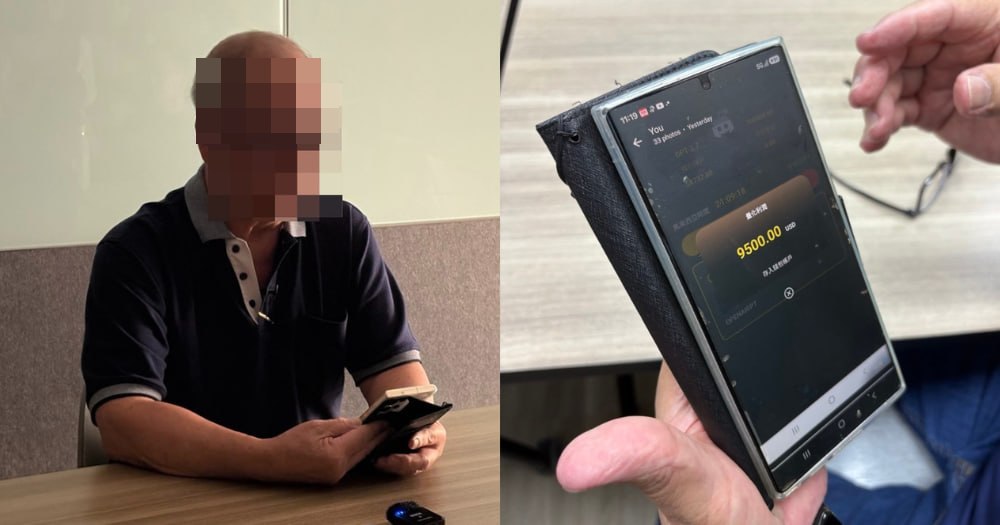
Speaking to media in an interviewed arranged by the Singapore Police Force, he said he had ignored those people.
None of those who had approached him had offered a rate of return as high or as attractive.
Very soon, he created an account on the platform and invested between S$1,000 to S$5,000 worth of cryptocurrency every two to three days.
He never got his money, nor any profits, back.
The platform turned out to be a scam.
Over about three months from November 2025 to January 2026, the man lost a total of S$70,755 to the platform.
This sum included his initial investments, and the amount he later depositied in an attempt to get his money back.
Investment scams like Ng's case remains the scam type resulting in most amount of money lost, according to the police's Mid-Year Scams and Cybercrime Brief 2026, released on Aug. 26.
Trusted her like a friend
Ng currently lives with his wife.
When the woman followed Ng on TikTok in early November 2025, he followed her back.
They started chatting on the app before moving to WhatsApp.
After chatting for a few days, the woman said she had something good to share with him.
She had been investing on a platform called AI Robots.
As it was AI-powered, it could work faster than human brokers at analysing data, and thus offered investors very high returns, she explained.
The woman claimed that she worked for the company and thus could not trade on the platform herself.
She asked if Ng could help her to manage her account instead.
Ng did not question what she told him about the platform because he treated her like a friend.
"She talked in a way that made me see her as a friend I could trust," Ng told reporters.
When he had an issue with his bank account, he shared about it with her, and she gave him advice.
Never met in person
Ng never met the woman in person.
He only had a photo, supposedly of her, that she had sent him.
The woman, who told him she was 35, claimed that she grew up and lived in Kuala Lumpur.
Although she used a Malaysia number to communicate with him, he recognised that she had a mainland Chinese accent when they spoke over the phone.
He questioned her about this, and she explained that she had picked it up from her father, who was from China.
For his retirement
Ng was also attracted by the high rate of returns the platform promised.
At the time, he thought he was getting older and wanted to retire.
Investing, he felt, was a way to keep earning money so he could enjoy a comfortable life after retirement.
He agreed to help manage the woman's account.
He then set up his own.
Suspicions
Ng did see the money in his account grow fast like the woman said.
"But although I could see [the money], I could not get it out," he said.
Issues started popping up on the platform that prevented him from withdrawing his funds.
In late November 2025, when his investments grew to S$50,000, the platform's customer service claimed his funds were blocked due to poor internet connection.
They said he needed to invest another S$50,000 to retrieve them.
Unable to raiser this sum, Ng went to his son for a loan.
His son, after understanding the situation, guessed that his father was being scammed, and advised him to make a police report.
By this point, Ng had already lost S$43,590.
Before the case was resolved, however, he returned to the platform, hoping to get his money back.
But the platform found new ways to get him to invest more.
In January 2026, the customer service claimed that he had to pay a 28 per cent income tax fee before he could make a withdrawal.
This was the final push that made Ng feel that something was not right, and he stopped putting more money in.
His second round of investments cost him S$27,165.
'Talk to your family more'
Ng's son did not know that his father went back to the platform after making a police report.
He only found out after Ng asked him for a loan again.
To pay the supposed income tax fee, Ng approached a moneylender he found on TikTok.
He thus needed money to pay the debt he owed the moneylender.
Looking back at what happened, Ng said that when he read about scam cases, he had always wondered why people would fall for scams.
Now, he said, he understood.
It was hard for him to assess the situation clearly at the time, he explained.
"When you encounter problems like this, talk to your family more," he advised others. "People around you can help you think clearly."
Lessons learnt
On hindsight, Ng said he felt that he was silly and naive to have believed in the promises of the investment platform.
He also admitted that he did not really know the woman who approached him on TikTok well.
His son questioned why he would trust a woman he had never met, Ng shared, and he could only say that he was "too simple-minded".
"I never thought that people would try to do anything bad to me," he said.
After realising he was scammed, he did not confront the woman, believing for a while that she was a fellow victim.
He grew suspicious of her, however, and decided to block her.
Though he continues to use TikTok, he said he will no longer talk to people who message him on the app.