Abroad


How & why did Italian marines end up raiding Toa Payoh (the ship)?
The ship, not the neighbourhood.
August 12, 2026, 03:43 PM
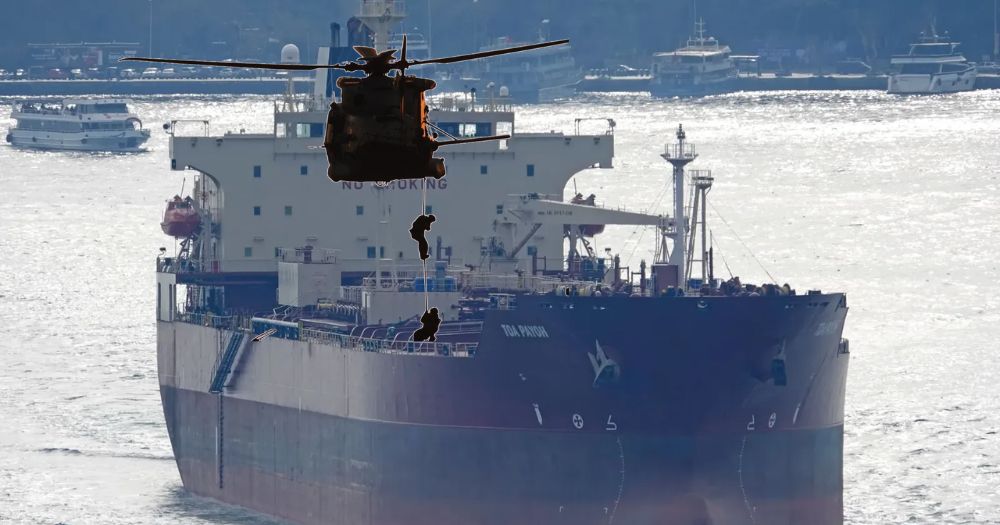
Image via Cengiz Tokgoz/Marine Traffic & Ministero Difesa/X


On Aug. 2, Toa Payoh was raided by Italian marines.
It’s about as bonkers a headline as you can get, leading to a bevvy of questions like what happened, and why the very localised name?
What actually happened?
On Aug. 2, as part of a joint EU mission led by the Italian Navy, supported by Greek and Polish vessels, Italian military personnel boarded an oil tanker named “Toa Payoh” in the Mediterranean.
The EU naval mission, named EUNAVFOR MED Irini, comes as the EU is attempting to intensify checks on vessels suspected of aiding Russia to evade oil sanctions, according to Reuters.
The Toa Payoh was in the Mediterranean, west of Sicily, while making its way from the African nation of Benin to Turkey, when it was intercepted by the EU naval mission.
The ship had changed the nation of its registration to Cameroon only the week before, having, according to vesselfinder.com, previously flown the Panamanian flag.
Helicopter boarding
The EU mission said that the Toa Payoh’s captain had initially failed to cooperate, which resulted in the Italian navy launching a team of military personnel to board the ship via helicopter from the Thaon di Revel, an Italian frigate.
The EU mission lacked the authority to seize the ship, but instead boarded the ship to check if it was legally allowed to fly the Cameroonian flag, as well as to check its registration documents.
The ship was not detained, but Reuters said that documents gathered during the boarding could be used by national authorities at a later time if needed.
The mission took just over two hours and was completed safely.
Why was it raided?
In July, the Toa Payoh changed its country of registration from Panama to Cameroon.
But while countries may grant ships the right to fly their flag, AP notes the United Nations Convention on the Law of the Sea (UNCLOS) Article 91, which states that while nations may choose to let ships fly their flag, “there must exist a genuine link between the State and the ship.”
This is likely what the EU was checking for.
But this explanation belies the deeper reason: the Toa Payoh is suspected to be part of the Russian “shadow fleet” that it uses to circumvent EU and United States sanctions placed on it due to its invasion of Ukraine.
This was the second such boarding of a vessel linked to Russia’s “shadow fleet” in the past month.
EU sanctions
The EU has heavily sanctioned Russia and its energy exports after its invasion of Ukraine in February 2022, resulting in a “shadow fleet” of vessels used to evade those sanctions.
The so-called “Shadow Fleet” comprises “hundreds” of vessels which Russia uses to move oil without Western Companies, who refuse to do so for fear of contravening U.S. and European sanctions.
The vessels are usually older ships that are difficult to operate normally in the West, sometimes raising safety and therefore insurance concerns.
In order to circumvent some of the rules, these ships are registered with other countries where oversight of concerns like safety and cargo is more lax.
Who’s responsible
The Toa Payoh is alleged to be part of that fleet, and is owned by what appears to be a shell company, Toa Payoh Lines Inc, based out of Dubai in the United Arab Emirates.
That shell company appears to be part of a network of ships owned by Mohammad Hossein Shamkhani, an Iranian businessman.
It should be noted that while the fleet is often called “Russian”, it is usually “Russia-friendly” rather than directly Russian-owned.
Iran and Russia are close allies, with the Iranian regime going as far as to provide Shaheed drones for Russia to use in its invasion and occupation of Ukraine.
Al Jazeera and a 2025 United States treasury department report said Hossein and the Shamkhani family are thought to be heavily involved in the export of Russian oil and petroleum products.
Al Jazeera reports that the network is known for taking sanctioned oil products and transferring them at sea, and for mixing those products with output from other countries, so that determining its precise origin is more difficult.
So what’s the connection?
In July 2025, the U.S. Treasury Department announced new sanctions related to Hossein which mentions the Toa Payoh and some companies registered in Singapore.
These companies are accused of being part of a network being used to launder money and hide the origins of the cargo carried by ships in the network.
Do those companies tell us anything about why the Toa Payoh is named what it is?
Sadly, no.
Shadow fleet vessels are notorious for changing their names often, and also their nation under which they're flagged.
It is a roughly 21-year-old chemical and oil products tanker that began its life as an Italian-flagged vessel named North Point.
It was renamed the Northern Ocean in 2011 and the Toa Payoh in November 2022.
So it might very well be that the naming is coincidental, merely one of the oddities of the world’s oceans, allowing for a humorous (in Singapore) headline.
Only in Yishun
Bonus info because some postulated the presence of a SS Yishun in the comments of the original post: There is also a ship named Yishun.
It’s a Taiwanese-flagged fishing vessel that operates in the seas around Japan and South Korea.
Nice.