Environment


Temasek reports S$49 billion in sustainable living investments, up S$3 billion from 2025
It reaffirmed its commitment to achieving net zero portfolio emissions by 2050, but notes that the transition will be uneven and non-linear.
July 08, 2026, 03:01 PM
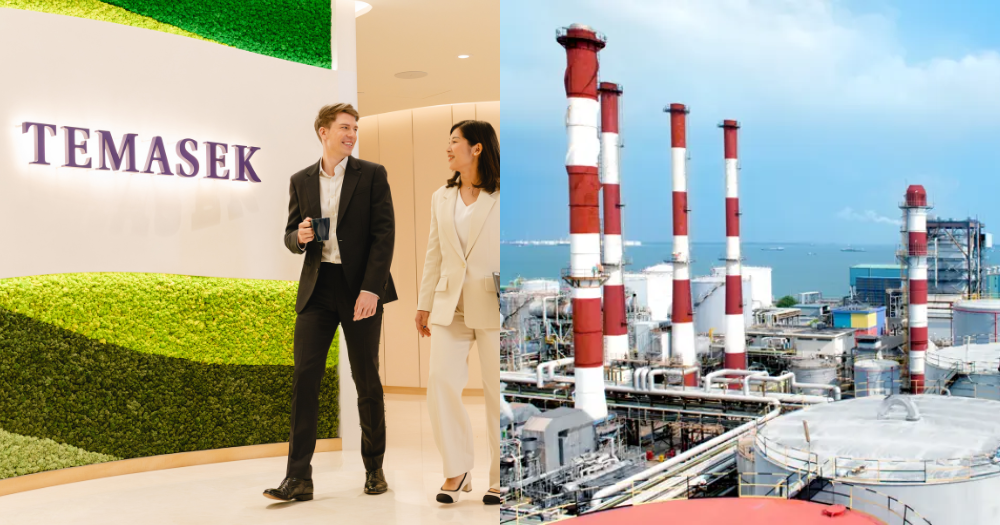
Photos from Temasek and Sembcorp Industries' website


Singapore’s state investment company Temasek reported S$49 billion in sustainability-linked investments as of Mar. 31, 2026, an increase of S$3 billion from the previous year.
They make up 9 per cent of Temasek’s net portfolio value.
This was announced in Temasek's Sustainability Report 2026, released on Jul. 8 along with its annual financial year review.
The report outlines the company’s sustainability goals, initiatives, and performance, including ongoing efforts to decarbonise its portfolio and reduce emissions.
For the third year straight since 2024, its total portfolio emissions held stable at 21 million tonnes of carbon dioxide equivalent (tCO₂e).
Sustainable living investments
Temasek has been working to align its investment activities with the "sustainable living trend" by investing in companies whose products and services advance environmental or social objectives.
Of the S$49 billion such investments, S$42 billion was made to businesses with products and services that contribute positively towards Temasek's long-term vision of net zero, nature positive, and inclusive growth.
The remaining S$7 billion focused on companies in high-emitting sectors actively transitioning towards greener products and services.
Over the past year, Temasek deployed S$5 billion in new and follow-on sustainable living investments, particularly in renewable energy and climate technology companies.
They include the Amperesand, a US- and Singapore-based company working to improve grid efficiency and support the needs of megawatt electric vehicle charging, the U.S.'s Luminace, which offers decarbonisation-as-a-service solutions to commercial, industrial, and public sector customers, and China's NARI Technology, which provides smart grid and power automation technologies.
Progress towards its goals
Temasek remains committed to achieving net zero portfolio emissions by 2050, a goal it set in 2019.
At the time, the company also set an interim target of halving net portfolio emissions from 2010 levels, to 11 million tCO2e, by 2030.
Now, it believes it is "unlikely" to meet this 2030 target under current conditions.
In the report, Temasek cited market volatility, higher financing costs, growing global energy demand, and portfolio exposure to hard-to-abate sectors such as steel, cement, power, aviation, and shipping.
"As a result, the transition will be more uneven, contested, and non-linear than previously anticipated," the company said.
Nevertheless, this does not reflect a step back from the long-term net zero ambition, it added.
Temasek said it has started a review its target to ensure that this 2050 goal remains "current, credible, and actionable".
"The review takes into consideration evolving methodologies and best practices in target-setting so that the ambition and assumptions underpinning our net zero commitment remain relevant and viable."
Portfolio emissions from Singapore companies
Singapore-based Temasek Portfolio Companies (TPCs) contributed 89 per cent of total portfolio emissions, with Sembcorp Industries (SCI) and Singapore Airlines (SIA) accounting for the majority of them.
SCI, Temasek said, plays a key role in developing solutions to support the clean energy transition, and is exploring low-carbon technologies such as green hydrogen and ammonia projects.
Temasek noted that as SCI completed its acquisition of Australia's Alinta Energy and its group of companies recently in June, it expects its emissions to increase in the near term before declining.
SCI thus foresees that it will not meet its 2028 target for emissions intensity and 2030 target for absolute emissions, but will target to achieve an emissions intensity of 0.26 tCO₂e/MWh by 2035.
It also remains committed to achieving net zero emissions by 2050, Temasek added.
As for SIA, the airline's emissions grew 3.8 per cent year on year, driven by resilient air travel demand, expanded overall operations, and longer routings due to airspace restrictions.
To reduce emissions, SIA has been working to deploy more new-generation aircraft, which is projected to improve fuel efficiency by up to 25 per cent for passenger services, and up to 40 per cent for freighter operations.
At the end of the financial year, 78 per cent of SIA Group's operating fleet comprised such aircraft, and this is expected to reach 90 per cent by 2030.
Deepening engagement
Temasek has been embarking on several initiatives to support their Singapore-based TPCs in climate transition.
It launched the TPC Ecosystem Workforce AI Fluency Programme in 2026, and has been co-developing a playbook under it to strengthen AI skills development in the workforce.
Using its Climate Transition Readiness Framework, Temasek engaged 19 major portfolio companies that made up 88 per cent of total portfolio emissions for the year, encouraging them to develop climate transition plans.
Among them, 15 have set targets to achieve net zero by 2050 or earlier.