News


SIA CEO's pay rises to S$9.7 million as revenue soars to record S$20.5 billion
However, SIA Group's net profit fell 57.4 per cent.
July 02, 2026, 06:09 PM
Top photo from Ryuno/Unsplash and Singapore Airlines Group


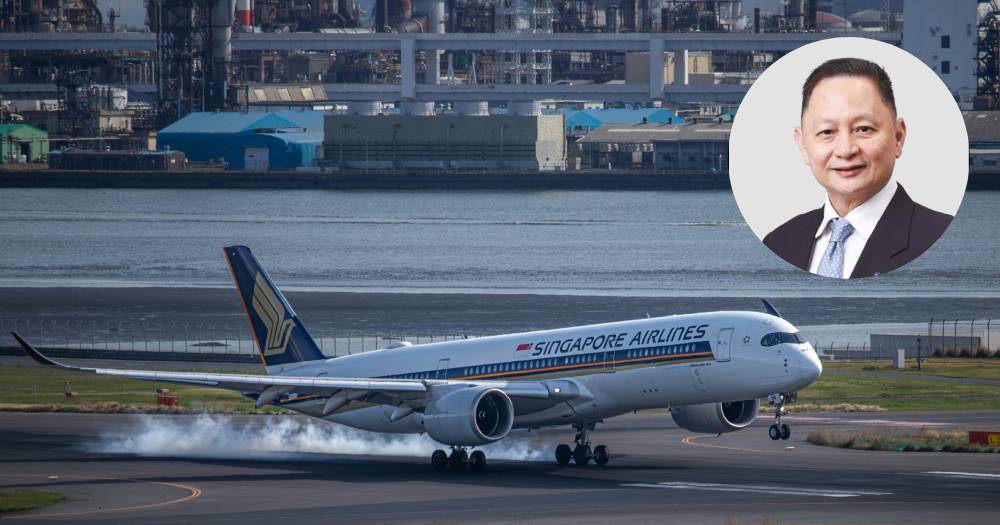
Singapore Airlines (SIA) Group chief executive officer, Goh Choon Phong, received a remuneration of nearly S$9.7 million in total for the last financial year ending Mar. 31.
This comes as the SIA Group recorded its highest-ever revenue of S$20.5 billion and carried a record 42.2 million passengers.
According to SIA's Annual Report for Financial Year (FY) 2025/26, Goh's remuneration comprised 15 per cent in base salary, 35 per cent in bonuses, 49 per cent in shares, and 1 per cent in benefits.
In the previous financial year, Goh received around S$7 million.
Conditional shares
Goh's base salary was S$1.456 million, and his total pay includes conditional shares awarded in July 2025 for SIA's performance in the 2024/25 financial year.
The share-based scheme is a long-term initiative introduced during Covid-19 to retain and incentivise key executives.
According to the report, the final tranche of shares was distributed in July 2025 to acknowledge SIA's senior management's efforts in ensuring the airline's full recovery from the pandemic.
The overlap of the final award and other grants under SIA's other share plans resulted in a temporary spike in share-based compensation in the latest financial year.
Other executives & directors
SIA Group Chief Commercial Officer Lee Lik Hsin and chief operations officer Tan Kai Ping received remuneration of around S$3.75 million to S$4 million, including the July 2025 strategic share award.
Their salaries could be broken down into 18 per cent in base salary, 39 per cent in bonuses, 41 per cent in shares and 2 per cent in benefits.
Scoot Chief Executive Officer Leslie Thng Kan Chung also received remuneration of between S$2.75 million and S$3 million.
Non-executive directors received remuneration of around S$160,000 and S$824,000.
The non-executive director with the highest pay was SIA chairman Peter Seah Lim Huat, who was given S$824,610.
The report said the compensation committee and board consider the resulting total compensation for key executives was "appropriate and not excessive, given the efforts and dedication of the Senior Management in managing the airline in a post-Covid operating environment".
Increased macroeconomic uncertainty amidst geopolitical tensions
In Seah's letter to shareholders, he said that "the airline industry faced rising geopolitical tensions, macroeconomic uncertainty, and continued supply chain disruptions".
"Towards the end of the financial year, the onset of the Middle East conflict resulted in a sharp increase in the price of jet fuel – the SIA Group’s biggest expenditure item – alongside higher inflationary costs and greater operational uncertainty."
However, Seah noted demand for air travel remained strong, and passenger numbers increased by 7.7 per cent from the year before.
He added: "The group's nimble response to the Middle East conflict bucked the broader industry trend of shrinking capacity and networks".
SIA Group's operating profit rose 39 per cent to S$2.4 billion, supported by higher yields and lower full-year net fuel costs.
Net profit fell 57.4 per cent
In his letter, Seah also noted that net profit fell 57.4 per cent to S$1.2 billion.
This was mainly attributed to the absence of the previous year's S$1.1 billion non-cash accounting gain from the Air India and Vistara merger and the group's share of full-year losses from Air India.
Seah said that "Air India faces well-publicised headwinds", but reiterated that SIA Group's 25.1 per cent stake in the enlarged Air India Group provides them with a direct stake in one of the world's largest aviation markets.
He added: "There has been progress in Air India’s long-term transformation journey despite these challenges".