Abroad

MS Explains: Is the Johor state election a 'starter pistol' for M'sia's next GE?
Johoreans choose.

 On Saturday, Jul. 11, voters in Malaysia’s southernmost state of Johor will vote for their representatives in the state assembly, the legislatures that create and pass laws within the individual states.
The Barisan Nasional-led state executive council was not due to call for a new election until the middle of 2027, but has decided to pull the trigger almost a year early, leading to speculation about the political impact of the move, both locally and nationally.
With Johor being Singaporeans' second favourite place on earth (okay, maybe third if you take Japan into account), and a major source of labour for Singaporean businesses, what do you need to know about the elections?
Who are the players, and how did we get here?
A starting gun, not a bellwether
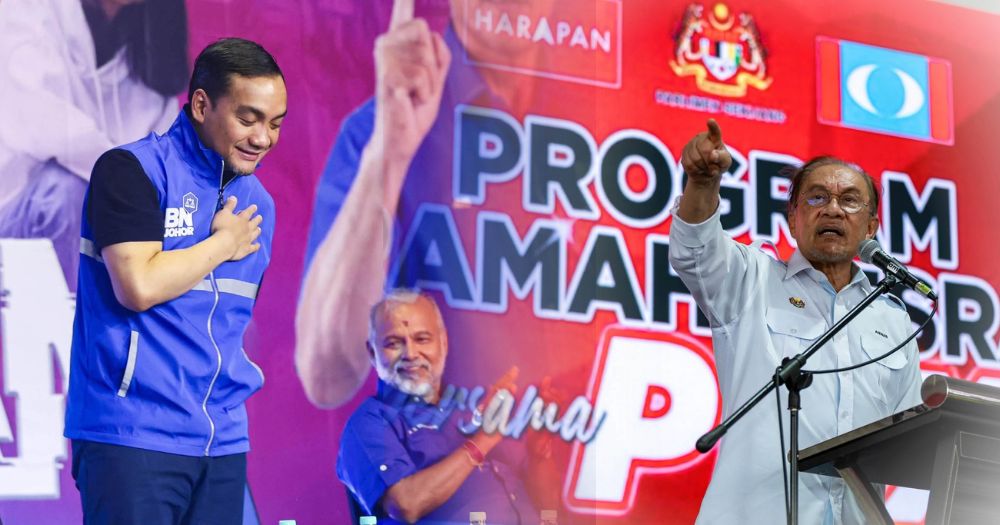
On Jun. 1, Johor's Menteri Besar (MB, Chief Minister) Onn Hafiz Ghazi dissolved the state assembly, setting the stage for the Jul. 11 polls after a month of suggesting that BN would contest all 56 seats without cooperating with its federal governing partner, Pakatan Harapan.
This has led to speculation that the elections are a starter pistol of sorts for the next general election (GE16), which BN has indicated it would likely contest alone, similar to what happened in 2022.
In the 2022 state election BN won 40 out of the 56 seats in Johor, a two-thirds majority, leading to predictions of a BN surge.
However this was not replicated on a national scale, with BN winning only 30 out of 222 seats, including only nine of Johor’s 26 parliamentary seats.
So state popularity is no sure sign of federal success, and federal unpopularity appears to be no barrier to state success.
This unity
Nonetheless, there are concerns over what BN’s decision to contest Johor alone will mean to the unity government formed between longtime foes Pakatan Harapan and BN’s Umno after 2022.
For the three and a half years, the unity government has worked amenably together, even contesting state elections on a combined platform.
But with a new GE required by Feb 2027, BN is likely using Johor to test the waters for what a post unity government Malaysia looks like, while simultaneously assuring the country that the unity government remains stable.
For example, on Jun. 7, Onn Hafiz swore that no matter the result, Johor BN “will never work” with PH’s largest party, the Democratic Action Party (DAP).
But a week later Onn Hafiz had a convivial public event with DAP leader and Transport Minister Anthony Loke, where Loke highlighted Johor’s reliance on his ministry’s support for projects like the cross-border RTS as well as local light rail.
The longevity of the unity government will depend on various factions being able to compartmentalise their politics from their policy agenda, but in May PH leader and Prime Minister Anwar Ibrahim warned that a failure to work together would leave him little choice but to call snap elections.
Re-form reform
Anwar’s PH faces a challenging time, having run in 2022 on a platform of reform and alleviating cost of living concerns.
Cost of living efforts were set back by the energy crisis caused by the US-Israel War on Iran and the closure of the Strait of Hormuz, something Anwar’s government could not predict nor prevent.
But his coalition has seen the departure of prominent figures such as former MUDA chief and Johor MP Syed Saddiq, and Anwar’s former right hand man and Economy Minister Rafizi Ramli.
Rafizi has gone on to start his own party, Bersama, and there are fears that he could siphon votes away from Anwar's coalition, allowing otherwise winnable seats for PH to fall to BN.
These concerns are particularly concentrated in the Chinese community.
On Jul. 9, 134 Chinese groups issued a statement urging out of state Johoreans to return home to vote, saying “giving up won’t change anything.”
Catalyst
UMNO and its chief minister are uniquely dominant in Johor, where it has fallen out of favour almost everywhere else in Malaysia.
It surely hopes that a strong showing can be a catalyst for its national fortunes, in spite of how things turned out previously.
Onn Hafiz is a prominent, relatively young leader in a time where UMNO’s leadership skews older, and has pedigree in the state: his great grandfather Onn Jaafar was also a Johor MB, and founded UMNO there.
He has made a name for himself pursuing economic growth and improving living conditions, often touting the Johor-Singapore Special Economic Zone (JSSEZ) as a path to economic growth, even speaking in Singapore on occasion to promote it to business leaders here.
On social media, he can be seen conducting surprise inspections of immigration staff to ensure that the crossing is as easy as possible for his constituents working in Singapore.
Unxodus
Singapore has been a hot topic in the election, although thankfully for relatively benign reasons.
According to Malaysian media, Johor natives working in places like Singapore and Kuala Lumpur (KL) have expressed their excitement to return home and cast their ballots on Jul. 11, some calling voting a “responsibility.”
Calls for offshore Johoreans to return home to vote appear to have become a key message of the authorities.
Malaysia’s immigration officials said a special taskforce has been set up to deal with expected traffic and potential disruptions at entry points between Singapore and Malaysia on polling day, with “dedicated lanes” for voters, said Malaysia's Home Minister Saifuddin Nasution Ismail.
“We will accommodate anything that can help facilitate Johor voters’ participation in the democratic process on polling day, to the best of our ability.”
Hundreds of thousands of Johoreans work in Singapore, with some residing there full time and many more taking the Causeway daily.
Some parties have also made explicit attempts to reach Malaysians outside of Johor.
In its Jul. 3 manifesto, the ruling Pakatan Harapan (PH) coalition outlined its proposed initiatives to make Johor the “Shenzhen” of Southeast Asia.
Among other initiatives to achieve this goal, it proposed a programme aimed at bringing 20,000 Malaysian professionals currently in Singapore back home to Johor by 2031, through job and entrepreneurship incentives.
Rafizi’s Bersama, meanwhile, is reportedly looking to organise an online event targeted at Johoreans in Singapore as part of its election campaign.
Non-interference
Malaysian Prime Minister Anwar Ibrahim said he does not intend to contact Prime Minister Lawrence Wong for help facilitating offshore Johoreans’ return on polling day.
Responding to a question in parliament on Jul. 7, he said, “Our relationship with Singapore is very good, and this helps develop both countries.”
“But I generally do not ask other countries to interfere in Malaysia’s affairs, including voting in our country,” Anwar added.
Say it softly: Landslide?
Also in the mix is the opposition Perikatan Nasional coalition which has largely campaigned under the banner of Malay unity, despite the growing schism between its two main parties, Parti Islam Se-Malaysia (PAS) and Bersatu.
The coalition is only contesting 33 out of 56 seats, and has urged supporters to vote for BN where they are not running.
Based on this strategy, they have been accused of not “seriously contesting in Johor."
BN is expected to do well again this Saturday, with the most pessimistic predictions seeing BN retain the government with a slightly reduced majority, and the most optimistic seeing a near total sweep, reducing PH to a handful of seats.