Features


From Low to Singh: Yee Jenn Jong on the evolution of WP & its leaders
"Parliament is like a modern-day gladiator arena. We do not fight with swords and rods, but with words."
July 04, 2026, 04:27 PM
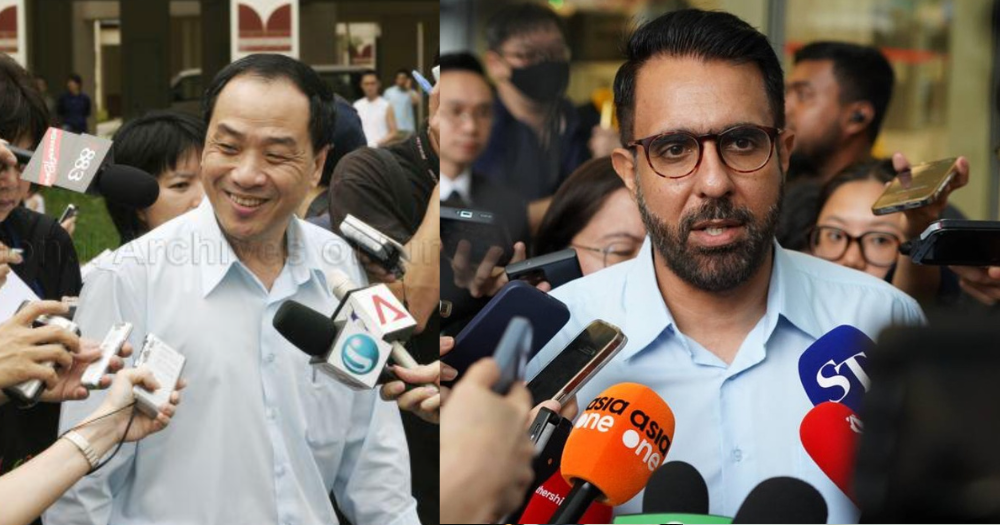
Photo from National Archives of Singapore and Andrew Koay/Mothership
Political parties in Singapore are, by nature, portraits of continued renewal.
The Workers’ Party (WP) is no exception. At the recent party conference on Jun. 28, cadres voted on the fate of secretary-general Pritam Singh.
Singh ultimately emerged triumphant, having secured almost 80 per cent of the vote — a feat some analysts suggested could be in part due to the support of his predecessor, Low Thia Khiang.
Singh went on to be re-elected, unopposed, as the WP chief in the party's Central Executive Committee (CEC) elections.
In “Step Up: The Workers’ Party of Singapore 2.0 — The Road to GE2025 and Beyond”, former WP parliamentarian Yee Jenn Jong and biographer Loke Hoe Yeong delve into the party’s evolution over the years.
An abridged excerpt from the book, from chapters 4 and 5 — “The Breakthrough Years under Low Thia Khiang” and “Pritam Singh Takes Over and Prepares for the Future” — has been reproduced here.
The book is available for purchase directly here or via Kinokuniya, Popular, Book Bar, and World Scientific (use promo code WSASOC20 for 20 per cent off).
By Yee Jenn Jong and Loke Hoe Yeong
In GE2011, Low Thia Khiang surprised the PAP by coming out of his Hougang SMC stronghold to lead the party’s “A” team — then comprised of NCMP Sylvia Lim, Pritam Singh, Chen Show Mao and Faisal Manap — against a strong PAP team led by George Yeo.
A key member of the PAP third-generation leadership, Yeo headed ministries ranging from Health, to Trade and Industry, to Foreign Affairs.
Yet, the WP managed to win 54.72% of the votes, up from 43.91% in GE2006.
Low kept close tabs on our performances during the 12th Parliament term. He was understandably cautious, given that the ruling party was ready to tear our proposals apart if there were loopholes or errors.
As a warning for us to be thorough in our facts and calculations, he cited the 1996 case of Chee Soon Juan and three others from the SDP. The group was charged and fined by the Committee of Privileges for falsifying data in a healthcare paper they had published.
As leader of the WP, Low was trying to ensure that the new parliamentarians pass their first term safely. I was not restricted in what I wished to say as long as my arguments were sound. We were responsible for preparing ourselves well.
Parliament is like a modern-day gladiator arena. We do not fight with swords and rods, but with words.
The next era
In 2001, Low took over under challenging circumstances and reorganised the party to recruit younger professionals and worked on rebranding the party.
From 2011 to 2020, the party strengthened its foundations to get ready for further pushes. To grow, it needed to expand its base.
It also had to find a way to run the town council despite encountering obstacles along the way. The challenges were eventually overcome: reliable staff were cultivated and an alternative information management system developed.
The party was ready to expand, if given the mandate.
In 2017, the highly respected Low made a shocking public announcement at the party’s 60th anniversary dinner that he would be stepping down after 16 years as WP leader. The cadres were to elect the next secretary-general at the Cadres’ Meeting in April 2018.
Prior to that, Low had prepared the ground, appointing Singh in 2016 as assistant secretary-general, a post that had been vacant since 2006. He had also met privately with a few of us in 2016 to broach the idea of his impending retirement.
I respect Low for knowing when to bow out. When he felt that the team from the class of 2011 and 2015 could take the party to another level, he let them take centre stage.
Often, when the party encountered challenges after Low’s retirement, particularly when Singh faced court charges over his handling of former MP Raeesah Khan’s lie in Parliament, people speculated that Low would make a comeback.
I would tell them no. Low had retired and did not believe that he must resurface to save the party. Low would provide advice from behind the scenes when called upon but he knew when it was time to let go.
Even if Singh was forced out of Parliament by a legal conviction, another leader from his generation would fill the position.
Such was Low’s confidence in the team that he had quietly built.
[...]
Success and setbacks
In 2020, with 10 elected seats in Parliament, the leader of the WP, Pritam Singh, was given the newly created title of Leader of the Opposition. It was the first time that the government officially recognised such a role.
Two years earlier, Singh had succeeded Low Thia Khiang as secretary-general, after Low stepped down from that position in 2018 at the age of 62.
After the new high of GE2020, the WP suffered several setbacks. The first was when Sengkang GRC MP Raeesah Khan admitted to lying on three occasions in Parliament over a speech she had first made in August 2021.
Although she resigned in November 2021, the matter was raised to the Committee of Privileges (COP), during which the WP’s senior leaders — Singh, Sylvia Lim, Faisal Manap — were questioned in marathon sessions, alongside Khan and other members of the party.
The remaining three members of the Sengkang GRC team continued to manage the town. In GE2025, the WP was re-elected with an even stronger mandate, 56.31% compared to GE2020’s 52.13%.
The aftermath
Singh has headed the party for only seven years since succeeding Low Thia Khiang but has already achieved much by the standard of Singapore’s opposition politics.
He also had to face relentless challenges by his opponents on his character over how Raeesah Khan’s case was handled. He led the party to win a second GRC in Sengkang and became Singapore’s first officially recognised Leader of the Opposition, a role which he held after GE2020 till January 2026, when the PAP-dominated Parliament voted to find Singh unsuitable for that position after he lost his High Court appeal over the conviction of lying under oath to a parliamentary committee.
Singh appears more willing to embrace the times, drawing volunteers systematically and even seeking professional services to expand the party’s media outreach. He has also demonstrated greater willingness to engage with the media, appearing in podcasts and on a chat show on national television.
At the same time, he is a disciplinarian like his predecessor, having enforced party discipline on several occasions when members crossed the line.
Singh has already announced the party’s medium-term ambition to deny the PAP its two-thirds majority in Parliament. That is a tall order given that it would need another 23 seats on top of the existing 10 elected ones.
But he sees his role as “normalising” the idea that even with a strong opposition, the Singapore government can still function well, like in other democratic systems.
Singh may yet try to use the same approach in the next general election: putting up the strongest possible slate of candidates and configuring them for possible wins in all the races. He has shown his willingness to field new and young candidates if they have the right attitude and can uphold the party’s 3Rs branding.
Hopefully, his boldness in contesting to win will secure positive results and allow Singh to leave a strong legacy of his place in Singapore politics.