News


URA to scale up non-invasive tech to detect underground utilities, reduce exploratory digging: Chee Hong Tat
Singapore has avoided about S$300 million in unnecessary re-routing costs since 2024.
June 14, 2026, 06:43 PM
Photos from Khoo Wen-en/Mothership and Underground Cable Detection Services Singapore


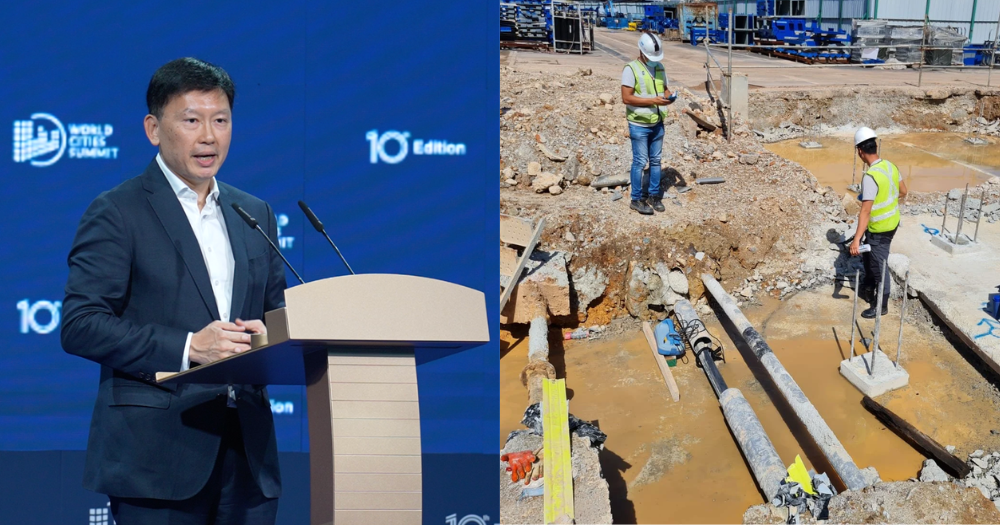
The Urban Redevelopment Authority (URA) plans to scale up the use of non-invasive technologies to detect underground utility networks, Minister for National Development Chee Hong Tat said on Jun. 14.
This method provides a clearer picture of what lies underground, and reduces the need for exploratory digging, which in turn reduces disruption for road users.
Speaking at the first day of the 2026 World Cities Summit Mayors Forum hosted at the Suntec Convention & Exhibition Centre, Chee explained that Singapore has already been using such technologies to supplement traditional trial trenches.
These technologies include electromagnetic locators and ground-penetrating radars.
Managing the underground space
In his speech, Chee spoke about several challenges and solutions for managing a dense, mature city.
One area he discussed was the management of Singapore's underground utilities.
"In Singapore, which is a land-scarce country, making better use of underground space is critical to optimising our limited land resources," he said.
"Beneath our city lies a complex and dense network of utility infrastructure, which requires capital planning and coordination."
However, conflicts might happen because different utility owners plan and handle their assets separately.
Underground utility records are often maintained across multiple systems and may not always be accurate, he added.
Contractors thus frequently need to carry out exploratory investigations to verify the locations of existing utilities before starting on projects.
"This can lead to repeated road openings, causing inconvenience to the public, increasing structure costs, and extending project guidelines," Chee said.
Solutions
Apart from using non-invasive utilities detection technologies, URA has also been working on improving the planning and coordination of underground utility projects.
Since 2024, the agency has put in place an enhanced workflow so that potential conflicts can be identified and resolved early before construction begins.
"To date, we have coordinated about 272km of utility corridors and avoided about S$300 million in unnecessary costs in having to re-route existing utilities halfway through construction," Chee shared.
To build more reliable shared records of Singapore's underground space, the Singapore Land Authority (SLA) has been developing a centralised submission portal for project teams to submit utilities data with locational information after completing works.
This portal is being trialled on selected projects in 2026 and will be scaled up in 2027, Chee said.
Partnerships between governments & residents
Chee highlighted the importance of collaboration in tackling urban challenges from underground management to municipal services.
On providing effective municipal services, he said it depends on strong partnerships between governments, communities, and residents.
"We encourage our residents to play an active role to improve their neighbourhoods and co-create solutions together with government agencies and businesses to tackle local challenges," he continued.
To help residents do so, the Singapore government has been improving data sharing across agencies, and enhancing digital platforms for residents to provide feedback and receive updates on agencies' actions more conveniently.