News


S'pore launches new supercomputer to support AI-driven research & national projects
Four times more powerful than previous two models combined.
June 08, 2026, 05:32 PM
Photos via Mothership


Singapore has launched its latest supercomputer that is four times more powerful than the previous two models combined.
The supercomputer, named Aspire 2B, will be used to support researchers and national projects and serve as a testbed for emerging AI-driven research approaches in fields such as healthcare, climate modelling, and urban resilience.
It is equipped with 1,500 Nvidia H200 Graphic Processing Units (GPUs), commonly used to train and run AI models.
Aspire 2B was launched on Jun. 8, 2026. by Minister for Digital Development and Information Josephine Teo at a launch event in Nanyang Technological University (NTU), where the new supercomputer is housed.
Large models can now be trained locally
Aspire 2B is the newest addition to the family of supercomputers put together by Singapore's National Supercomputing Centre (NSCC).
Speaking at the launch, Teo acknowledged the computing power of the Aspire 2B.
However, she said: "In any case, rather than to focus on the numbers, we should be looking at the scope and substance of our experimentations going forward."
"With Aspire 2B, models that were previously too large can now be trained in Singapore to meet our specific needs," she added.
Teo cited climate modelling as one example of how Aspire 2B can help researchers do more.
With Aspire 2B, researchers can develop advanced "climate modelling approaches that combine AI and physics-based simulations for higher resolution forecasting and more granular climate insights".
"This can help us anticipate intense rainfall and rising seas earlier, and plan our whole urban development and coastal defences around them," Teo shared.
The minister also gave the example of Meralion, the world's first multi-modal model that understands Southeast Asian languages.
Such language models will be "valuable" to companies operating in the region, Teo explained.
Teo added: "Our measure of success cannot be limited to the scale of hardware available. What matters is how well we use the infrastructure."
People and skills are also essential to turn hardware accessibility into tools, the minister said.
Terence Hung, chief executive at NSCC, said Aspire 2B will provide researchers with the "compute capabilities needed to tackle larger and more complex challenges in areas critical to Singapore’s future, including healthcare, sustainability and urban resilience".
"Aspire 2B reflects Singapore’s ambition to strengthen its position in trusted AI and advanced computing," Hung added.
NSCC, founded in 2015 to build Singapore's supercomputing capabilities, celebrates is 10th anniversary in 2026.
Aspire 2B
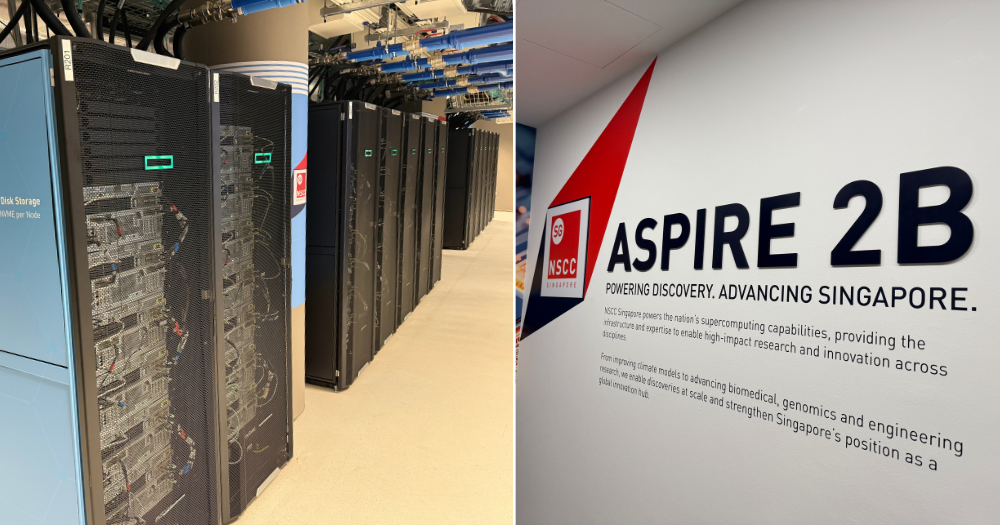
Aspire 2B is housed in NTU in a facility that measures around 400 square meters.
It is powered by about 1,500 Nvidia H200 GPUs and 184,000 AMD CPUs.
Aspire 2B offers four times the combined computing capacity of its predecessors, Aspire 2A and 2A+.
It will also more than double Singapore's national GPU capacity.
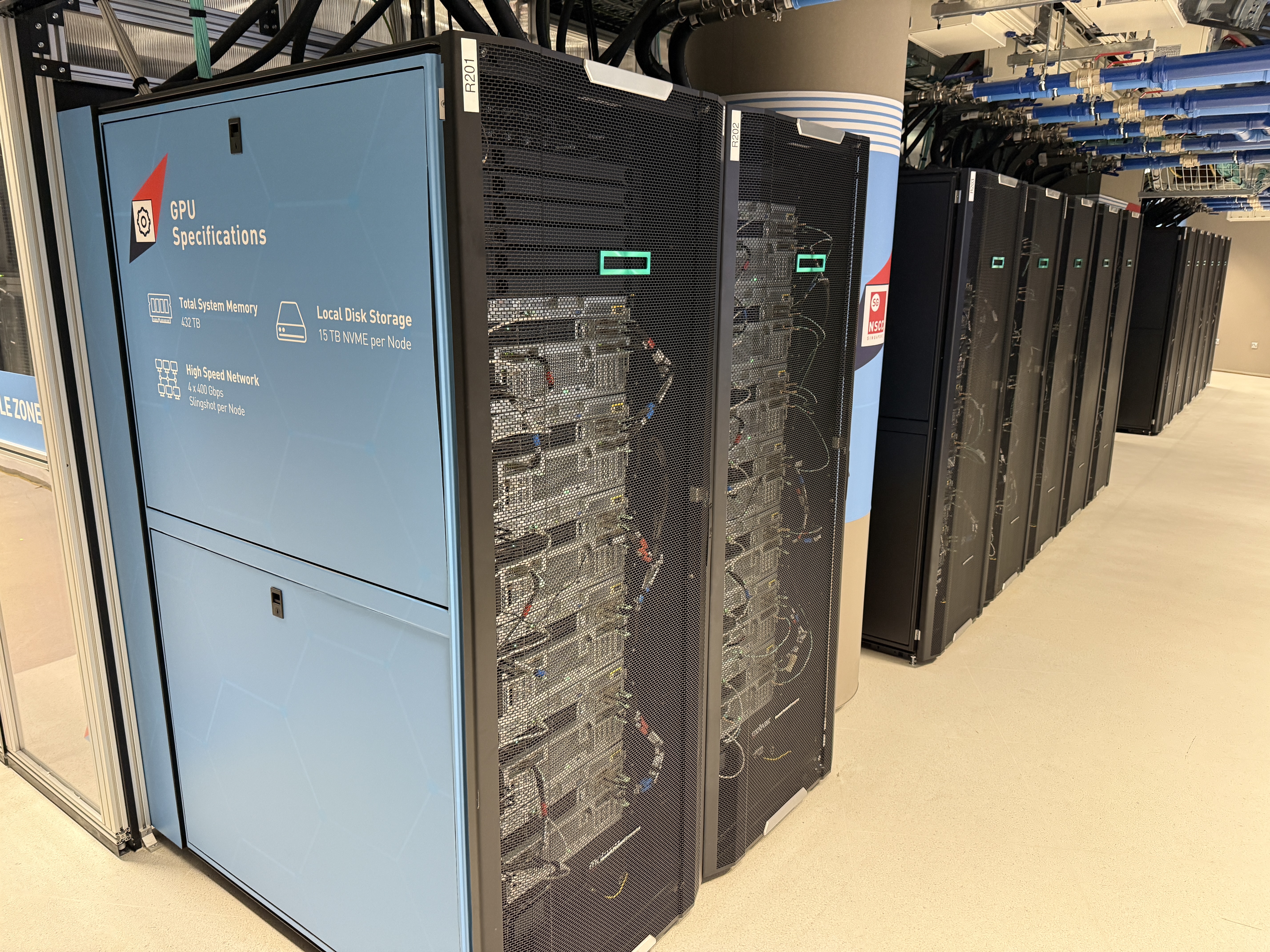 Photo via Mothership.
Aspire 2B's GPUs alone will deliver the combined computing power of 120,000 high-end AI laptops.
Altogether, it will deliver up to 115 petaFLOPS of compute power and is capable of more than 100 quadrillion calculations per second.
FLOPS stands for "floating-point operations per second" and is the unit of measurement to calculate the performance capability of a supercomputer, according to HP.
One petaFLOPS equals one quadrillion (1,000,000,000,000,000) FLOPS.
"To illustrate the scale of 115 petaFLOPS, if every person on Earth performed one calculation every second, it would take more than 170 days to match what Aspire 2B can process in a single second," NSCC explained in a press release.
Aspire 2B will be able to provide "enhanced support for integrated workflows combining simulation, data, and AI within a single ecosystem", NSCC described.
Examples of national projects that Aspire 2B will be used for include Simfoni, a Ministry of Health-supported project that aims to strengthen the use of AI in healthcare settings.
Aspire 2B will also be linked to a new quantum computer, which is expected to be installed in Singapore near the end of 2026.
The linking of the two computers will enable researchers to "solve complex problems that are difficult for both systems to handle alone", NSCC said.
S$270 million
Plans for Aspire 2B were first announced in 2024 by then-Deputy Prime Minister Heng Swee Keat during the launch of Aspire 2A and 2A+.
Heng said then that Singapore will commit S$270 million to developing the next-generation supercomputer.
Aspire 1, Singapore's first supercomputer, was launched in 2016.
It was then Southeast Asia's most powerful supercomputer.
Aspire 1 was decommissioned in August 2023, ahead of the launch of Aspire 2A and 2A+ in October 2024.
Aspire 2A and 2A+ are housed in the National University of Singapore.
Aspire 2A+ ranked 90th in the top 500 supercomputers list in 2024.
The Aspire supercomputers have supported national programmes, such as the National Environment Agency's Third National Climate Change Study.
Comparing the supercomputer models, NSCC explained that Aspire 2A supports "CPU-intensive workloads", such as climate modelling, materials science and engineering simulations, and Aspire 2A+ "strengthens capabilities for AI and accelerated computing".
On the other hand, Aspire 2B will bring these capabilities together "at a greater scale", and enable "more complex and integrated research" in various fields and research areas.
Aspire stands for "Advanced Supercomputer for Petascale Innovation Research & Enterprise".