News


S'pore man graduates with Harvard PhD after getting rejected by local universities, credits those who gave him a chance
He said in his speech at Harvard that his school in Singapore discouraged him from studying biology due to poor grades, despite his interest in it.
June 14, 2026, 03:13 PM
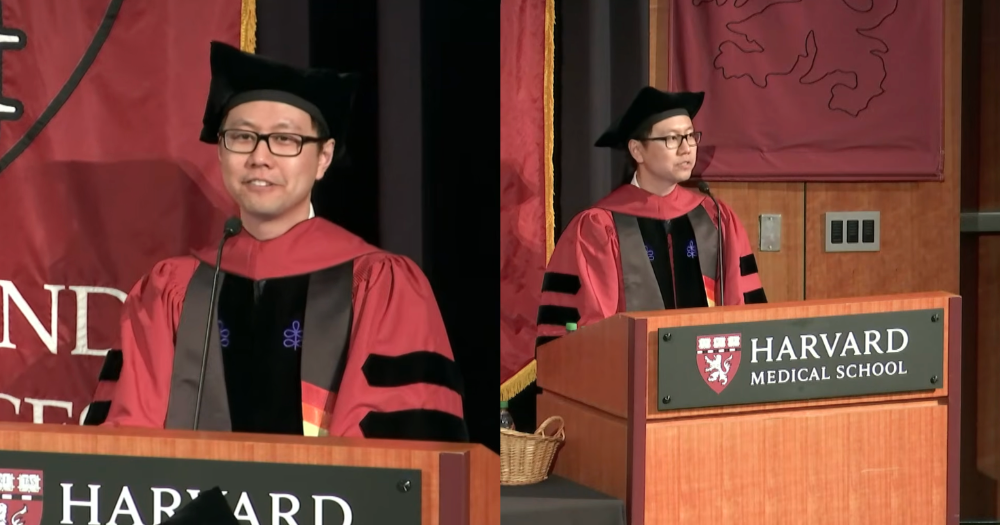
Photos from Harvard Medical School's YouTube


Despite a passion for biology, Joel Tan believed for a while that higher education was not for him due to his low grades.
That was what the man from Singapore was told directly and indirectly, then seemingly affirmed when no Singapore university would take him in despite two application attempts over two years.
He decided to apply overseas, and got accepted to the University of Toronto, where he found his path in research that would lead him to a PhD in biological and biomedical sciences at Harvard.
"Someone opened a door that had been closed to me, and because of that, I eventually found my way here, to Harvard," he said in a student address at the May 28 hooding ceremony for Harvard Medical School-affiliated PhD programmes.
"Not a realistic path"
Recounting his journey in the speech, Tan shared that his path in education was "not always obvious or straightforward" growing up in Singapore.
"In high school, I really wanted to study biology, but I was told many, many times that it was not a realistic path for me," he said.
"My middle school grades were not good enough for the supposed rigours of biology classes, and I was forced to take the easier sciences like physics and chemistry."
His grades suffered in those subjects because he was not given a chance to study what he was truly interested in.
Opening doors
When the University of Toronto took a chance on him by accepting him into their undergraduate programme, that chance "changed" his life.
Tan was finally able to take his first biology class, and the school also gave him access to mentors, labs, and a community that allowed him to discover who he could become through science.
"I often think about how much of my life depended on someone, somewhere, deciding that my past performance did not have to define my future potential," he said.
He added: "There are people with curiosity, creativity, and potential who may never get a chance to show what they can really do unless an institution, a mentor, or a community opens the door for them."
"Potential is everywhere"
He used his roughly 11-minute speech to highlight the importance of diversity in the student body, saying that the collision of people from different countries and backgrounds makes science and research stronger.
"We need people who arrived here with perfect grades and people who needed that third chance," he said. "We need people whose paths were straightforward and people whose paths were anything but, because science is stronger when more people can contribute to it."
He urged his fellow graduates to become people that open doors for others, to make science more welcoming and accessible to the next generation:
"Talent is everywhere. Curiosity is everywhere. Potential is everywhere. And if there's anything that we've learned on this long road to the stage, it is that sometimes a single opportunity is all you need to achieve your goals."
According to the speaker who introduced Tan, he will continue his research as a postdoctoral fellow, focusing on addressing neurodegeneration.