News


Only 10% of S'pore employees under 35 feel engaged at work, over half face stress daily: 2026 Gallup report
Senior leaders said the well-being programmes their organisations provided seem ineffective at preventing work overload.
June 22, 2026, 05:30 PM

Photo from Canva


Only 14 per cent of Singapore's workforce felt engaged at work in 2025, lower than the Southeast Asian proportion of 25 per cent and the global mean of 20 per cent.
This was reported in Gallup's 2026 Singapore Workplace Report published on Jun. 22.
It added that the trend is not new, as Singapore has stagnated around the same level of engagement since 2019.
There is a significant generational divide in workplace engagement.
Among younger employees under 35, 10 per cent felt engaged, compared to 16 per cent of their older counterparts.
This split is higher than the two percentage point difference found globally between younger and older employees.
Reasons for lower youth engagement
Singapore's young workers are not less willing to work, according to 16 senior leaders Gallup interviewed for the report.
"Rather, they are working in conditions that foster lower engagement and wellbeing and induce greater levels of stress for them than for their older coworkers," the report wrote.
Singapore workers under 35 recorded experiencing more stress, worry, anger, and sadness daily than older workers.
Compared to 37 per cent of older workers who face stress daily, 53 per cent of younger ones experience it.
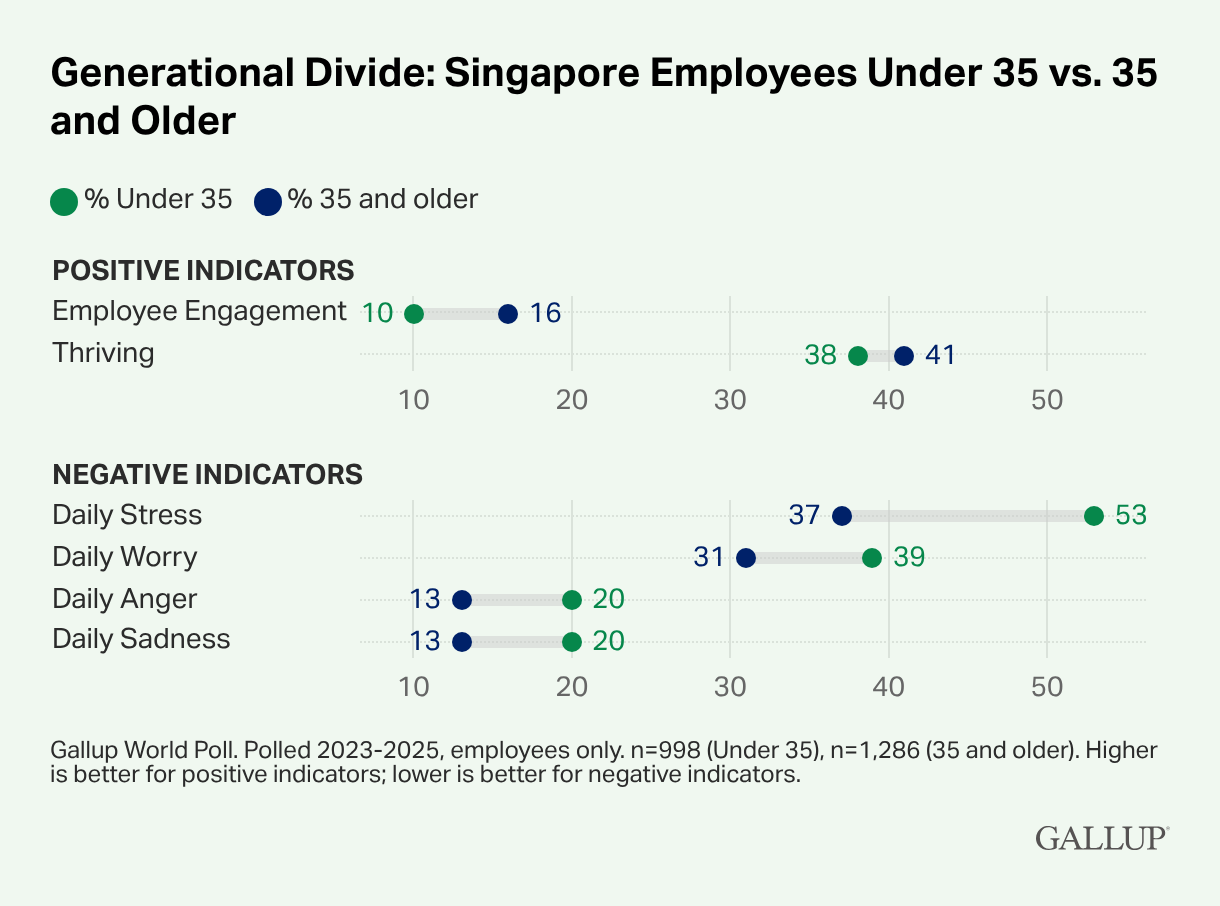 Image from Gallup
The Gallup report highlighted that while late millennial and Gen Z employees are frequently perceived as "fragile and ill-equipped to handle life and work pressures", the generational split is real and not imagined.
"Consequently, Singapore’s employers need to respond to the unique needs of younger employees," it went on.
Additionally, many of the interviewed leaders blamed this low level of engagement on external factors such as global market forces, challenging economic conditions, or labour market policy.
Others attributed it to the many family-owned small and medium-sized businesses in Singapore, and the highly competitive business environment.
Purpose and resilience
Speaking at the launch of the report on Jun. 22, Minister of State for Manpower Dinesh Vasu Dash called attention to the low 14 per cent rate of worker engagement.
He said it raises the question: "How can we build an engaged workforce and a workplace together?"
Engagement is important for workers as it brings about a deeper sense of purpose and greater resilience through changes over the course of their career, he said.
"For Singapore, an engaged workforce accrues to a powerful engine of sustained economic growth and, most importantly, social cohesion."
Dinesh added that the government has been working with tripartite partners to strengthen fair and inclusive workplaces, including through legislative and regulatory tools.
Positive well-being
In his speech, Dinesh also pointed out that Singapore performed better in terms of overall wellbeing.
Among Singapore employees, 40 per cent rated their lives positively enough to be considered "thriving" in 2025.
This figure dropped by two points from the previous year, but it is higher than the Southeast Asian average of 36 per cent and the global average of 34 per cent.
However, the report found that well-being programmes at workplaces do not appear to be effective at preventing work overload.
Most of the leaders Gallup interviewed affirmed that such programmes provided by their organisations do not change employees' day-to-day experience of work.
"Employees value these programmes, but they address the consequences of poor well-being and disengagement rather than their root causes," the report said.
Role of managers
In terms of improving worker engagement, many Singapore leaders believe managers are one of the most important drivers of whether employees are motivated and engaged.
The Gallup report found that 70 per cent of the variance in team engagement is attributable to the manager.
Rather than strategic plans, employee town halls, and annual surveys, strong relationships between employees and their manager are more powerful at creating and sustaining engagement.
"If the managers are doing a really good job of direction setting, coaching, reward and recognition, even if the workload is very high, I do think the employees remain engaged," one of the leaders interviewed said.