



Environment


Rare 'red alert' severe haze warning for S'pore, Aug-Sep 'peak danger period': SIIA
The last time a high-risk rating was issued was in 2023, and increased haze incidents did occur.
June 24, 2026, 05:28 PM
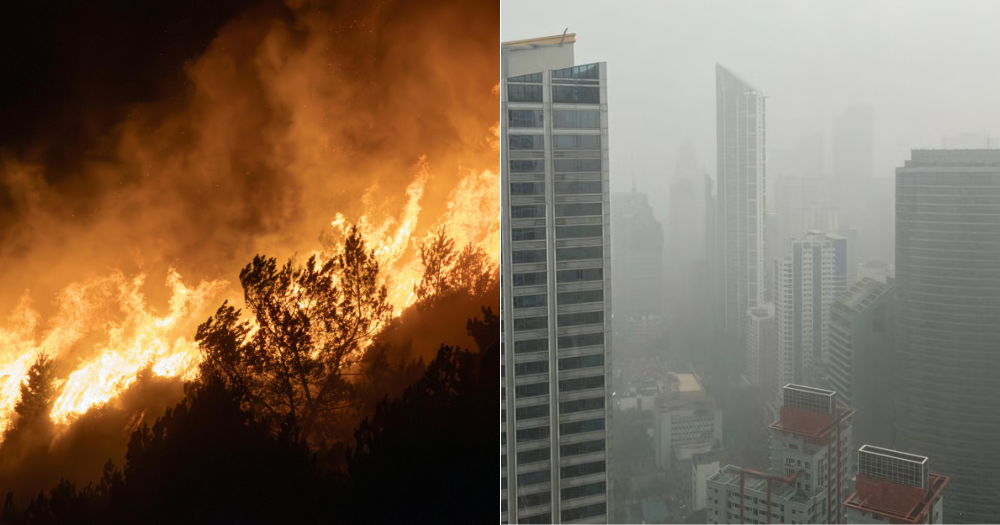
Photo from Canva & Ryan Weaver/Pexels


The Singapore Institute of International Affairs (SIIA) has issued a rare "red" alert, its highest risk rating, in its annual Haze Outlook report.
In a Jun. 24 statement, it warned of severe transboundary haze across the rest of 2026, affecting Singapore, Brunei, Indonesia, and Malaysia.
The report identified August to September as the "peak danger period".
The heightened risk is driven by a combination of factors, including the returning El Niño phenomenon and a surging demand for biofuels, said the research institute and think-tank.
The report evaluates haze risks by consulting governments, businesses, think-tanks, and non-governmental organisations.
Rare alert
This marks only the second time the SIIA has triggered a red alert since the annual report launched in 2019.
The last time the institute issued a red rating was in 2023, a year that ultimately saw a spike in regional haze incidents.
According to the report, the coming months could bring "one of the hottest and driest dry seasons on record", increasing the danger of land fires that could spread out of control.
The report also suggested that given the prevailing conditions, 2027 may end up being the hottest year on record.
Why so hot?
Historically, the most severe haze episodes have occurred when El Niño and a positive Indian Ocean Dipole (IOD) overlapped, such as in 1997, 1998, 2015, and 2023.
The IOD is a climate pattern characterised by fluctuations in sea surface temperatures across the Indian Ocean.
El Niño conditions are under way as of this month, while the less-predictable IOD remains a possible compounding factor.
However, the report noted that either climate pattern alone can trigger severe haze, as seen during the IOD-driven dry spell in 2019.
Biofuel boom
Other factors, including human activity, may also affect the incidence of haze.
In January 2026, Singapore faced several weeks of hazy conditions following the spreading peat fire in Johor, Malaysia.
SIIA warned that in the months ahead, growing biofuel demand caused by disruptions at the Strait of Hormuz may increase incentives for unsustainable land clearing among some producers.
These pressures are expected to persist even if the Middle East conflict resolves.
Khor Yu-Leng, associate director of SIIA, explained:
"The fuel crisis is also driving demand for biofuels, with Southeast Asian countries increasing the percentage of vegetable oil in diesel at the pump.
This trend will continue even if the U.S.-Iran agreement holds, as countries now want energy independence."
ASEAN cooperation
Despite the forecasts, "we must not be fatalistic", said Simon Tay, chairman of SIIA.
Indonesia has strengthened its institutional response to forest and land fires, and businesses have expanded fire prevention measures in recent years.
The think-tank called for regional cooperation and sustainable land management to minimise risks and strengthen climate resilience.
“ASEAN needs to take greater ownership of this challenge as the region enters a potentially severe dry season and faces the longer-term impacts of climate change," he said.
"There is much that can be done to prevent the worst and strengthen climate resilience, energy and food security, and regional cooperation... Supporting solutions with adequate funding will be critical.”