News


ERP 2 roadside electronic parking on trial in Aug. 2026, S'pore to gradually remove physical ERP gantries
LTA is gathering feedback about the effectiveness of the proposed ERP 2 road signs and markings, among other trials.
June 15, 2026, 06:28 PM
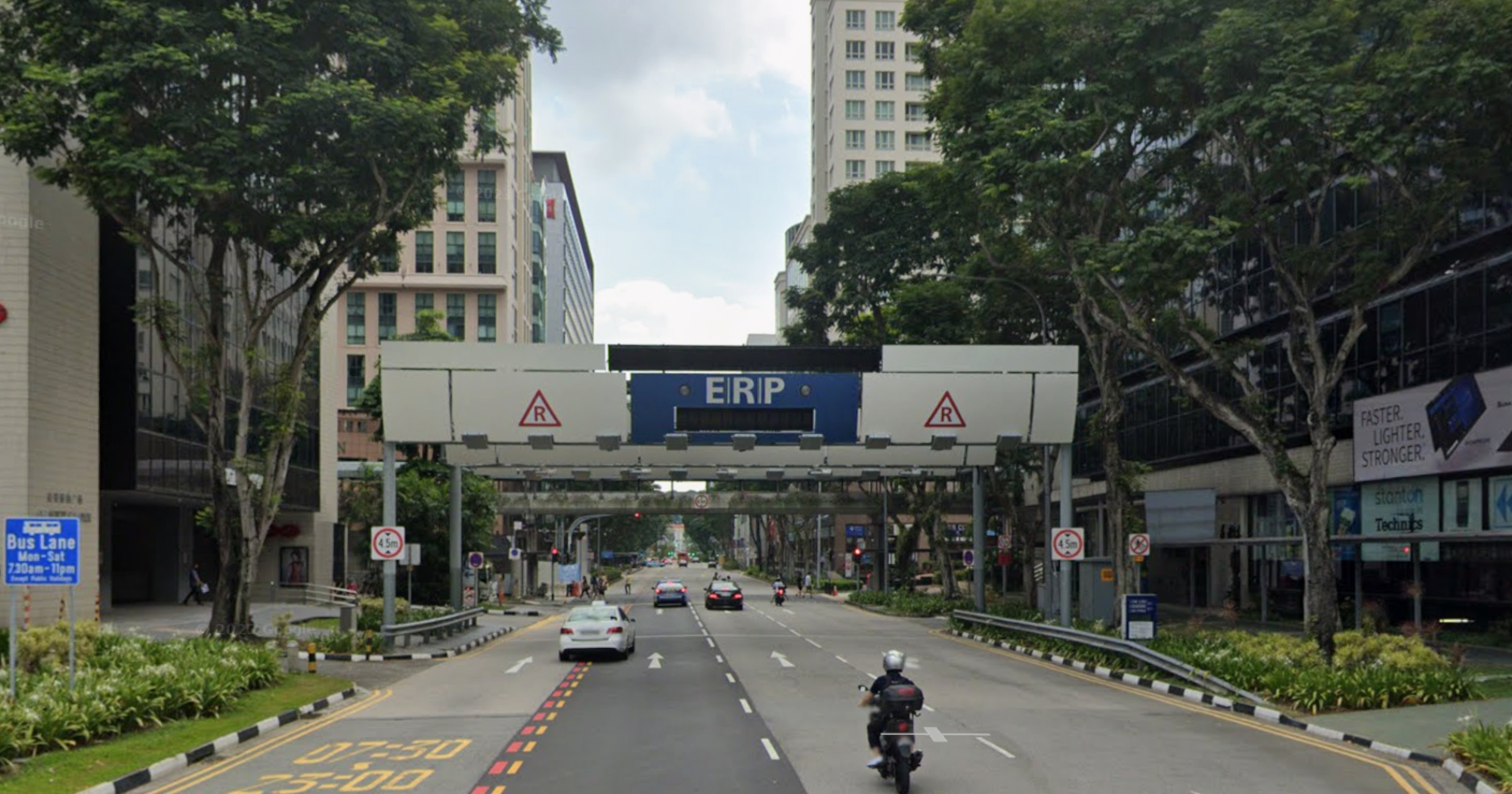


From Jan. 1, 2027, the gantry-based Electronic Road Pricing (ERP) system will be phased out.
Singapore will switch to the satellite-based ERP 2 system.
Physical ERP gantries will hence be progressively removed from later in 2026, starting with those that are no longer in operation.
ERP 2 uses Global Navigation Satellite System (GNSS) technology to determine a vehicle’s location to implement charges.
This eliminates the need for physical gantries on Singapore's roads, said the Land Transport Authority (LTA) previously in May 2026.
Trial ongoing
The user experience of ERP 2 will be different from the current gantry-based system.
As such, about 1,000 motorists, mostly passenger car owners and motorcyclists, are participating in a user experience trial under the second phase of the study for ERP 2.
A small number of drivers of taxis, goods vehicles, buses and coaches, and heavy goods vehicles, as well as the media, are also participating in the trial.
The second phase started on Jun. 1, 2026.
Participants will be subsequently asked to provide feedback through surveys regarding the effectiveness of the proposed ERP 2 road signs and markings.
They will also share their user experience, including the ease of paying for roadside parking via the On-Board Unit (OBU).
Designs of ERP road signs and markings after first phase
The two-phase user experience study first began in March 2026.
LTA has refined the designs of the ERP road signs and markings for the second phase, following feedback provided after the first phase.
This is in anticipation of the absence of physical ERP gantries after they are removed.
Five different combinations of road signs and markings are being tested across five expressways and arterial roads from Jun. 1 to Jul. 31, 2026.
The five locations selected for the trial road markings and signage are near existing ERP gantries.
PIE westbound after Kallang Bahru on Woodsville Flyover
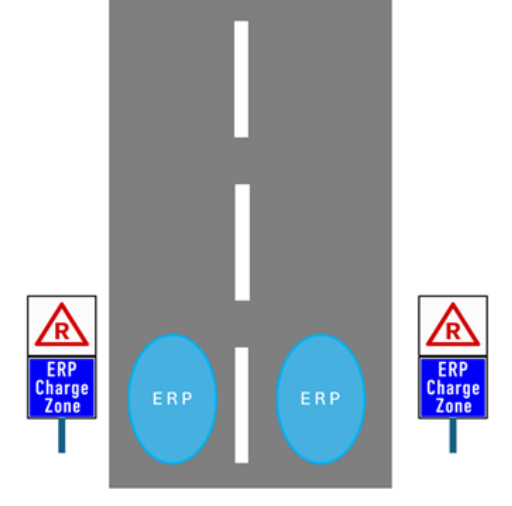 An oval blue “ERP” symbol will be painted on each of the five lanes, to indicate the start of the ERP charging location.
CTE southbound from Serangoon Road
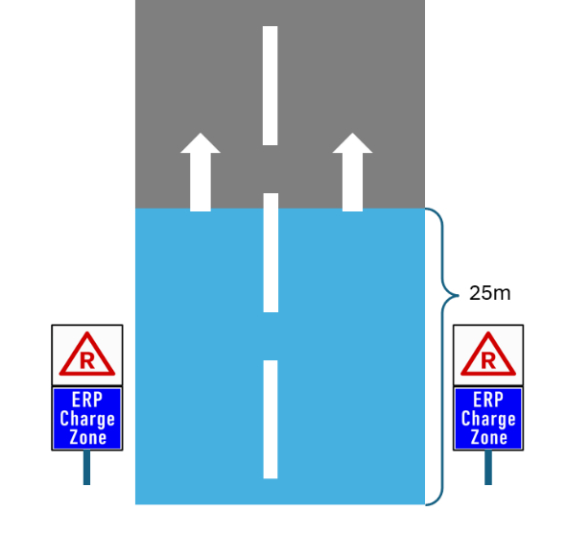 A 25-metre stretch of road painted in blue to indicate the stretch of the ERP charging location.
PIE westbound before Eunos Link
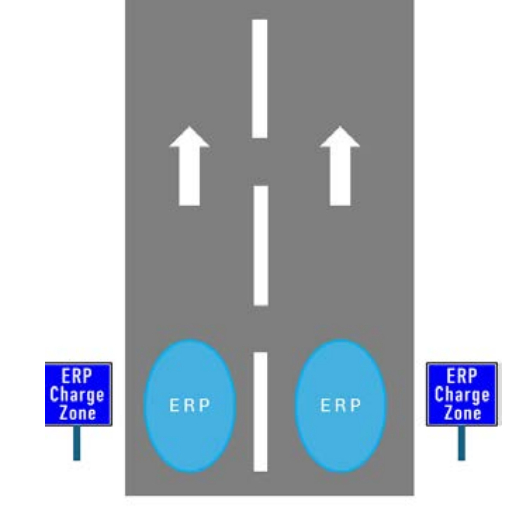 An oval blue “ERP” symbol will be painted on each of the four lanes, to indicate the start of the ERP charging location.
Marina Boulevard to MCE eastbound
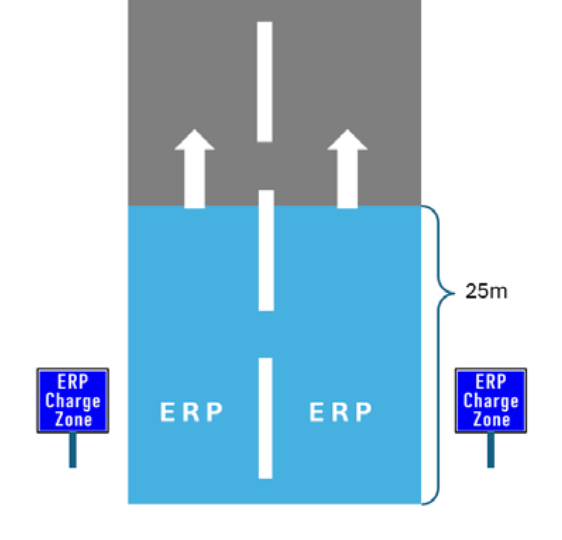 A 25-metre stretch of road painted in blue to indicate the stretch of the ERP charging location, with the words "ERP" in white painted in the centre of each lane to indicate the start of the ERP charging location.
AYE citybound after Jurong Town Hall
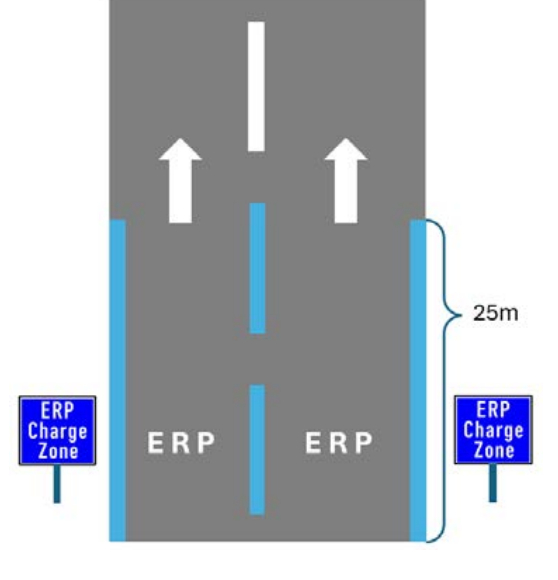 A 25-metre line painted in blue at the sides of the road to indicate the stretch of the ERP charging location, with the words "ERP" in white painted in the centre of each lane to indicate the start of the ERP charging location. The corresponding lane dividers will have their colours changed from white to blue as well.
ERP alert zones
Currently, those participating in the trial will get alerts when approaching ERP charging locations.
The ERP alert zones are located at the last possible exit before motorists reach the ERP charging locations.
This is to allow motorists to consider an alternative route to avoid the charge.
However, the distance between an alert zone and the ERP charging location depends on the road design and location.
Motorists can expect to receive the “ERP Ahead” notification from their OBUs at approximately 200m before arriving at an ERP charging location on expressways.
On smaller arterial roads, it will be approximately 60m.
Currently, motorists will be alerted to the pricing of the gantry they are approaching.
The amount will then be deducted after passing the ERP charging location.
Roadside electronic parking (REP) feature
Trial participants who have the OBU touchscreen display installed are able to progressively access more ERP 2 features as they are being tested.
Starting from August 2026, a total of 644 designated car park locations across Singapore will be involved in the roadside electronic parking (REP) pilot trial.
This comprises about 19,000 parking lots.
Other car parks will be progressively added to the REP system during and after the pilot trial.
No need to manually stop parking charges
Once implemented, motorists can start their parking session by tapping on the “P” icon on the OBU touchscreen.
Alternatively, a parking prompt will appear on the OBU after the vehicle’s engine is switched off.
The parking prompt will appear for approximately two minutes, which motorists can press to start the parking session.
The OBU will automatically shut down after that.
Motorists are required to confirm the start of a parking session, as this verifies their intention to park.
This is similar to the Parking.sg app.
The new system gives motorists greater control over when a parking session begins, ensuring that parking charges are applied accurately under the REP system.
Once the vehicle leaves the parking location, the OBU can automatically detect the vehicle’s departure, end the parking session, and calculate the parking charges.
This eliminates the need for motorists to manually end their parking session.
Picking right option for parking location
In the event that multiple nearby parking locations are shown on the OBU touchscreen, motorists should choose the correct location from the list, which is typically the first option.
Motorists without the OBU’s touchscreen display may continue to use the Parking.sg app to pay for parking.
Parking sessions activated via the OBU or Parking.sg app allow for a more seamless parking experience for motorists and are recorded by the authorities for verification purposes, LTA said.
The Parking.sg app will also remain in operation after REP is fully rolled out.
Other ERP 2 features to be rolled out for trial participants
The automatic payment of checkpoint tolls will be rolled out from mid-June 2026.
Participating off-peak car owners will also be able to pay for usage license using the OBU from the fourth quarter of 2026.
The trial will allow LTA to gather feedback on ERP 2’s features and user interfaces and make refinements where necessary before a full rollout to all motorists.
More than 96% of vehicles have ERP 2 OBU
As of May 31, about 960,000 vehicles or more than 96 per cent of vehicles in Singapore have installed the ERP 2 OBU, LTA said in its latest update.
The remaining vehicles that are required to do so must install the new unit by Dec. 31, 2026, ahead of the transition to ERP 2 from Jan. 1, 2027.
Among the vehicles installed with ERP 2 OBU, about 98 per cent have opted to install the touchscreen display which has the full suite of ERP 2 features.
These features include the payment of outstanding ERP charges, payment of roadside parking charges, and the temporarily disabling of CEPAS card payments for complimentary parking.
Foreign-registered vehicles have been allowed to install the ERP 2 OBU since Apr. 1, 2026.
Over 5,700 foreign-registered vehicles have opted in.
This includes all cross-border taxis under the enhanced Cross Border Taxi Scheme launched in May 2026.