News


Budget 2026 Comment: S’pore’s new AI strategy is a much needed experiment, with challenges ahead
All in.
February 12, 2026, 11:03 PM



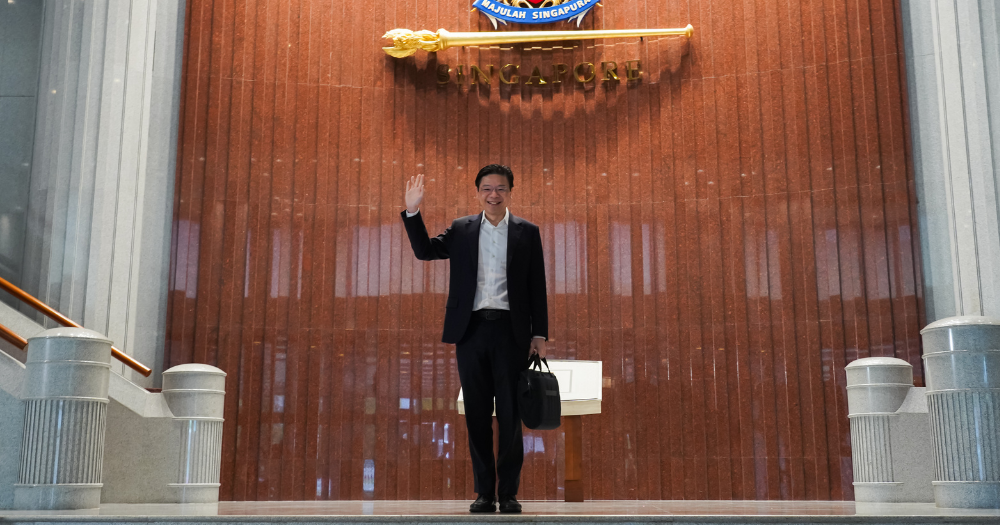
Prime Minister and Finance Minister Lawrence Wong delivered the 2026 budget statement on Feb. 12, and one of the standout policies was what amounts to a great AI experiment.
If you need a TL;DR on it: Singapore is going all in on AI.
This isn’t a surprise, but with every major policy speech and budget that passes, the purpose, peril, and promise of “going all in” comes into sharper focus.
Purpose
The AI portion was a relatively short, but important part of PM Wong’s speech.
Rhetorically, it got the sentiment right.
First, an acknowledgement that “The pace of change (due to the emergence of AI in the workplace) can be unsettling, especially when livelihoods are at stake”.
He provided the raison d'être for Singapore going all in on AI:
"Harnessed well, AI will be a strategic advantage for Singapore. It can help us overcome our structural constraints — our limited natural resources, rapidly ageing population, and tight labour market".
He also shared how we can play to Singapore's strengths.
"Our advantage does not lie in building the largest frontier models. It lies in deploying AI effectively, responsibly, and at speed. Singapore can be a trusted hub where companies and researchers come together to develop, test, and deploy impactful AI solutions — and do so faster and more coherently than many larger countries".
It was coupled with a promise that no Singaporean worker, present or future, would be left behind.
Fine words, but it required a benchmark of commitment.
The part that really got my attention was the provision of six months' worth of premium AI tools for Singaporeans taking selected AI training courses.
As PM Wong said, learning needed to go beyond theory into hands-on application.
“This will allow them to practice, experiment, and apply what they have learnt.”
Commitment
More details on what those tools are exactly will be presented in the upcoming weeks during the committee of supply debates, but here’s a simple example of what might be on offer.
A well-known AI application provides four tiers of access: free, S$11, S$30, and S$300; meaning that six months of access equate to S$66, S$180, and S$1,800.
I assume that the consideration will not be that straightforward, but the difference between an S$11 and S$30 subscription is that the more expensive one gives access to coding and agentic models, something more clearly needed in the modern workplace.
Basically, the tools provided will give a very clear idea of what the government expects of those in the workplace.
It’s a very pragmatic approach; perhaps it speaks to my general cynicism that the provision of something this necessary should surprise me.
But it clearly feeds into the purpose of the policy.
Peril
What comes next is the peril.
Indulge the reminiscing of an elder millennial for a moment, one who remembers living through the Dot Com bubble as an observer; too young to be working or invested in the market as it collapsed (and Singapore wasn’t as affected as other places).
But what occurred to me as I saw promising company after promising company fall was that the service they provided wasn’t some kind of idle fancy; several (although clearly not all) offered services that would become commonplace within a decade.
The problem was that their promise outran the capabilities of the internet’s infrastructure at the time.
There are warning signs that something similar is in place now.
In a decade, we’ll probably be using technology derived from this current generation of AI, but who knows whether the AI darlings of today will survive till then (although the megacorps probably will).
The only way out is through
A colleague pointed out the impact of AI-generated slop or AI-enabled scams and the risk of further immersing our society in the technology, not to mention the impact to local creatives that sloppily generated AI content can have.
I suspect that these are known considerations, as I mentioned earlier, we don’t really have an AI future as much as an AI present.
We have crossed the threshold that, for good or for ill, we are not going back to a day before AI (unless you believe in the onset of the Butlerian Jihad and the folly of making a machine in the shape of a human mind. It’s a Dune reference.).
Retreating is not an option; the only way through is making sure Singaporeans gain the familiarity of and sensitivity to AI tools, to effectively tell the difference, something that can only be gained through consistent use.
Put another way: no ones getting better at spotting slop by not using AI.
Promise
And it was interesting to hear PM Wong articulate exactly what he thought a human’s place in this new industrial revolution is: “higher value activities, work that requires judgement, creativity, and human insight”.
As an oft-quoted IBM training manual from 1979 prophetically put it:
“A computer can never be held accountable, therefore a computer must never make a management decision.”
It acknowledges that this current generation of AI is a tool: a well-made tool of immense potential, but like any tool, a human user is needed, and the more familiar that human is with the tool, the finer the craft will be.
One critique of government that I sometimes hear is that it can be overcautious at times, choosing to monitor options rather than resorting to action.
I’m on the fence on that one, because in many cases, much of what the government is trying to achieve is being attempted elsewhere.
That presents the opportunity to learn from other countries’ experience, and then implement a solution that fully caters to Singaporean needs.
But this isn’t what’s happening here.
The god of gaps
This is the Singaporean government highlighting a gap in a global market, and trying something all countries probably need, but few are attempting: the remaking of an entire economy, maybe an entire society.
I’m on record for being a fan of the SkillsFuture experiment that Singapore is running.
During industrial revolutions, progress is always made at the expense of man over the machine, whether it is weavers being replaced by sewing machines, saboteurs throwing their clogs into machinery, or even coal miners being replaced by windmills.
Notably absent from those years were attempts to reach back and bring those left behind forward, sometimes governments don’t even pay lip service to such efforts.
That’s why it's so hard to compare what’s being attempted here to previous attempts. I’m sure there have been some, but certainly none so successful that they’ve become ingrained in our memories.
So when hearing PM Wong say that the government means to make sure no Singaporean will be left behind, and that he intends to secure them good jobs and a good living, I really hope it works, as we all should.
Because that’s the promise.
Top image via Canva & Mothership